Why Your Thoughts and Emotions Are More Powerful Than You Think
Share This Post
Every moment of your life is shaped by something you cannot see. Before any action takes place, before any word is spoken, before any decision is made, something happens first—a thought arises, followed by an emotion. Most people treat these inner experiences as secondary, fleeting, or even meaningless. But what if they are not? What if your thoughts and emotions are not weak side effects of biology, but powerful forces that actively shape reality itself? In Life in 24 Dimensions, this question is not approached emotionally or symbolically, but logically. The book challenges one of our most deeply held assumptions: that only physical things are truly real. If something cannot be touched, measured, or weighed, we tend to assume it is less important. Yet this assumption collapses the moment we examine how human experience actually works.
You experience thoughts and emotions constantly. They never turn off. They guide your choices, shape your relationships, influence your health, and determine how you see the world. A force that operates continuously, universally, and with measurable consequences cannot reasonably be dismissed as insignificant. To understand why thoughts and emotions are so powerful, we must first understand what reality actually consists of. The book introduces a radical but carefully reasoned idea: reality is not purely physical. Instead, it is composed of both physical and non-physical dimensions, working together as a unified whole. Physical dimensions explain space, matter, and time. Non-physical dimensions explain consciousness, thoughts, emotions, free will, and meaning. One does not exist without the other. Science has done an extraordinary job explaining how the physical universe behaves, but it struggles when asked why human experience feels meaningful, purposeful, or emotionally rich. This is not because those experiences are imaginary, but because they exist in non-physical dimensions that science rarely addresses.
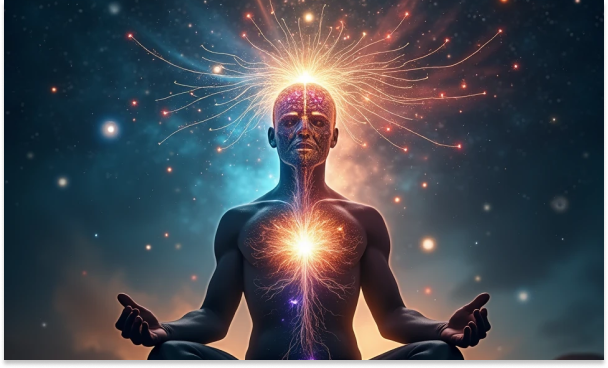
Thoughts and emotions belong to this non-physical reality. They are not random noise created by the brain. The brain is a mediator, not the source. Just as a radio receives a signal but does not generate the music, the brain allows thoughts and emotions to interface with the physical world. The experience itself exists beyond the material structure. This distinction matters, because it elevates thoughts and emotions from passive experiences to active forces. In the book’s dimensional framework, emotions—especially—play a central role in how physical and non-physical realities interact. They act as bridges between inner experience and outward expression. This is why emotions can influence behavior, decision-making, and even physical health. They are not isolated events; they are interaction variables within reality itself. Among all emotions, love and fear stand at opposite ends of the spectrum. Fear is reactive. It narrows perception. It fragments understanding. When fear dominates thought, it drives separation—between people, ideas, and even within the self. Much of human conflict, suffering, and confusion arises from fear-based thinking.
Love, on the other hand, is expansive. It integrates rather than divides. It creates coherence rather than chaos. Love allows understanding to grow rather than collapse. In dimensional terms, love aligns non-physical reality with harmony and meaning. This is why the book emphasizes choice as a critical element of existence. Human beings are not trapped in a deterministic universe. Free will exists because reality itself allows for choice and chance. Every thought you entertain and every emotion you dwell in nudges your experience in one direction or another. Your inner world is not neutral. A fearful thought repeated over time shapes a fearful life. A loving thought sustained over time reshapes perception, behavior, and ultimately experience. This is not mystical thinking—it is logical. If thoughts and emotions are real forces within non-physical dimensions, then repetition strengthens their influence, just as repeated physical forces reshape material structures. The author’s personal experiences reinforce this understanding. Throughout the book, he explains how direct encounters with non-physical reality—through consciousness, intuition, and lived experience—confirmed what logic already suggested: there is more to reality than the physical world alone. This leads to one of the book’s most comforting and transformative knowledge: you are not your body. If thoughts and emotions exist in non-physical dimensions, then consciousness does not begin with the body, nor does it end with it. The physical body changes, ages, and eventually dies—but non-physical reality is not bound by those limitations. Thoughts and emotions do not occupy space. They are not subject to decay. They do not obey the same rules as matter. This reframes death entirely. Rather than annihilation, death becomes a transition—one in which consciousness continues beyond the constraints of the physical form. What you truly are is not erased, because what you truly are was never physical to begin with. Thoughts and emotions, therefore, are not temporary illusions. They are expressions of a greater, more permanent reality.